
best
Best Canes
Families comparing Canes need a tighter shortlist, simpler criteria, and buying guidance rooted in real home use.
The best cane is not necessarily the one with the widest base or the longest feature list. It is the cane that gives the right amount of support, fits the user's body, feels comfortable in the hand, and is easy enough to use every time they stand up. For many older adults, that is a simple adjustable offset cane. Someone who travels may prefer a folding model, while a person with greater balance difficulty may need a quad cane—or an assessment for a walker instead.
Our shortlist covers those different jobs. We prioritized useful adjustment ranges, replaceable tips, realistic weight limits, comfortable grips, and designs from established mobility-equipment makers. Product specifications and prices can change, so confirm the exact model before ordering. Prices in this guide are approximate retail ranges as of August 2026.
> **Safety note:** A cane is suitable for mild balance problems or limited unloading of one leg. It cannot compensate for major weakness, frequent falls, or a need to bear substantial body weight through both arms. A physical or occupational therapist can assess gait and fit the device. New weakness, dizziness, or a sudden change in walking needs medical attention rather than a quick equipment purchase.
Best Canes for Seniors at a Glance
| Pick | Best for | Key specifications | Typical price | | --- | --- | --- | --- | | Drive Medical Gel Grip Offset Cane | Best overall | 30–39-inch handle; 300-pound capacity | $25–$40 | | Drive Medical Folding Cane with Gel Grip | Travel and occasional use | Folds into four sections; 32–36 inches; 300-pound capacity | $25–$40 | | HurryCane Freedom Edition | Self-standing convenience | Pivoting three-foot base; 30.5–37.5 inches; 350-pound capacity | About $40 | | NOVA SugarCane | Comfortable multi-tip support | Offset soft grip; pivoting quad tip; self-standing | $35–$55 | | NOVA Large-Base Quad Cane | Maximum support in a cane | 29.5–38.5 inches; 250-pound capacity; 2.5 pounds | $35–$60 | | Drive Medical Glow N' Go Folding Cane | Nighttime visibility | Glow handle and tip; 33–37 inches; 300-pound capacity | $30–$45 |
These are category recommendations, not a substitute for individual fitting. A basic cane that matches the user's height and balance needs is safer than a premium model that is too short, hard to lift, or awkward around stairs.
Best Overall: Drive Medical Gel Grip Offset Cane
The Drive Medical Gel Grip Offset Cane is the sensible starting point for most families. Its offset shaft places the user's weight over the cane, while the broad gel handle spreads pressure more evenly than a narrow tourist-style crook handle. The one-button height setting runs from 30 to 39 inches, and a locking ring helps reduce movement and rattling at the joint. Drive rates it for users up to 300 pounds and includes a wrist strap.
That combination is practical for everyday movement through a house, medical office, or store. The cane does not fold or stand by itself, but fewer mechanisms also mean fewer things to align before walking. Its ordinary 3/4-inch tip is straightforward to inspect and replace. For someone trying a cane for the first time, this model offers adjustability without making the device feel complicated.
The gel grip will not suit every hand. A very soft handle can feel less precise to someone with reduced sensation, and any grip can cause discomfort when the cane is carrying more load than it should. Try the handle with the person's usual hand position. Stop and reassess if it produces numbness, wrist pain, or a deep palm impression.
**Best for:** Daily use, mild one-sided weakness, or osteoarthritis when a conventional single-tip cane provides enough stability.
**Skip it if:** The cane must fit into carry-on luggage, needs to stand independently, or the user remains unsteady with a single tip.
Best Folding Cane: Drive Medical Folding Cane with Gel Grip
Drive's folding gel-grip cane breaks into four connected sections for storage and reassembles with an internal elastic cord. It keeps the hand-friendly gel grip and supports up to 300 pounds, but its 32-to-36-inch handle range is narrower than our overall pick. Measure before buying: a person who needs a setting outside that range should choose a different cane, regardless of how convenient the fold looks.
A folding cane is most useful when portability determines whether the cane comes along at all. It can ride in a tote during a flight, fit beside a restaurant chair, or serve as a backup in a caregiver's car. The included clip holds the sections together when folded. Once open, each joint should seat completely before the user puts weight on it.
The compromise is that folding models require more hand coordination and inspection. A user with weak grip, low vision, or cognitive impairment may not reliably confirm that every segment is locked. Elastic cords also wear over time. For someone who uses a cane from morning to night and rarely stores it, the solid-shaft offset model is simpler.
**Best for:** Travel, outings, and people who can assemble and check the cane independently.
**Skip it if:** The user needs a very short or tall setting, struggles to align the sections, or tends to walk before checking equipment.
Best Self-Standing Cane: HurryCane Freedom Edition
The HurryCane Freedom Edition combines a folding shaft with a small three-foot base that pivots as the user moves. The manufacturer lists eight height positions from 30.5 to 37.5 inches, a capacity of 350 pounds, and a folded length of 13.75 inches. It weighs less than one pound and sells for about $40 through the brand's store.
Its appeal is easy to understand: the base can stand on a level surface, so the user may not have to lean the cane against a counter. The pivot can keep more of the base in contact as the shaft changes angle. That is convenient for someone who repeatedly drops a standard cane when reaching for a wallet or opening a door.
Treat “self-standing” as a convenience, not a guarantee. A cane can still fall when bumped, placed on a slope, or left with the flexible base angled from the previous step. The three small feet also create a larger footprint than a single tip and can catch a stair edge if the user does not lift the base fully. Replacement feet are proprietary, so availability and correct installation matter.
**Best for:** Someone who values a compact folding cane and often needs to park it beside a chair or counter.
**Skip it if:** The user shuffles, has trouble clearing a multi-foot base, or expects it to provide the stability of a full quad cane.
Best Multi-Tip Cane for Hand Comfort: NOVA SugarCane
The NOVA SugarCane pairs an offset shaft and soft grip with a compact four-contact tip. NOVA says the base pivots on uneven or sloped ground and lets the cane stand on flat surfaces. Unlike a traditional quad cane with a metal base extending to one side, this tip stays centered under the shaft, making it easier to switch hands and somewhat less cumbersome in narrow spaces.
This design fills the gap between a single-tip cane and a large quad cane. It may feel more planted at a stop, and the offset handle can be friendlier to a sore wrist. It is still a cane, however; four small contact pads close together do not create the broad support polygon of a large quad base. A pivoting tip may also feel unfamiliar to a person accustomed to a rigid shaft.
Before committing, let the user try turning, backing up, and crossing a doorway—not just walking in a straight store aisle. Check that the base returns smoothly and that all four pads wear evenly. If one side remains off the floor or the cane must be forced upright, verify the height and technique.
**Best for:** A user who wants a self-standing, centered base and a cushioned offset handle without moving to a large quad cane.
**Skip it if:** The person needs substantial lateral support or prefers the predictable feedback of a rigid single tip.
Best Quad Cane: NOVA Large-Base Quad Cane
For the most support available within the cane category, NOVA's large-base quad cane has a roughly 12-by-7-inch footprint and a low center of gravity. Its offset handle rotates so the base can be set for left- or right-hand use. The published handle range is approximately 29.5 to 38.5 inches, the capacity is 250 pounds, and the cane itself weighs 2.5 pounds.
The wide base can be useful after a stroke or when a clinician has identified a need for more lateral stability. It stands on its own and may remain planted while the user pauses. The tradeoffs are meaningful: it is heavier, slower to reposition, and more likely to meet a stair riser, chair leg, or the user's foot. The long side of the base must face away from the body so the feet do not obstruct the walking path.
Quad canes work best with instruction. The user must place all four tips flat before loading the handle and cannot safely rush the sequence. If lifting and advancing 2.5 pounds causes fatigue, or if the user carries the base tilted on two feet, the theoretical stability advantage disappears. Ask a therapist whether a two-wheel walker would provide safer, more natural support.
**Best for:** A clinician-guided transition after stroke or injury when a single-tip cane is insufficient but one-handed support remains appropriate.
**Skip it if:** The user walks quickly, has limited arm strength, navigates tight cluttered rooms, or needs bilateral weight-bearing support.
Best for Nighttime Visibility: Drive Medical Glow N' Go Folding Cane
The Glow N' Go is a folding aluminum cane with a soft silicone handle and sections that glow in the dark at the handle and tip. Drive lists a 33-to-37-inch adjustment range and 300-pound capacity. The glowing areas can make the cane easier to locate beside a bed and help a caregiver see where its tip is in a dim hallway.
Visibility features should supplement adequate lighting, not replace it. A motion-activated night-light, clear path to the bathroom, secure rugs, and shoes with good traction address hazards the cane cannot. Glow performance will also depend on prior light exposure. Test the cane in the actual bedroom rather than assuming it will remain bright through the night.
As with any folding device, confirm that every section is fully joined after storage. This model is worth considering when the user already fits its height range and nighttime retrieval is a recurring problem; the glow feature alone is not a reason to accept a poor fit.
**Best for:** A user who needs a portable cane and frequently has trouble finding a dark-colored cane at night.
**Skip it if:** The needed height falls outside 33–37 inches or the home needs more fundamental lighting and fall-hazard improvements.
How We Chose These Canes
We compared canes by the decisions that affect day-to-day safety, not by the number of accessories attached. Our criteria included:
- **Fit range:** The handle must reach the user's wrist crease while they stand upright in their normal shoes. A wide advertised “user height” range is less useful than the actual handle-height range.
- **Base matched to need:** Single tips are light and maneuverable. Compact multi-tips add parking convenience. Large quad bases trade speed and clearance for more support.
- **Grip and shaft geometry:** Offset handles position load over the shaft and offer a broad surface. Grip size and material still need to match the individual hand.
- **Manageable weight:** A heavier base is not automatically safer if the user cannot clear it from the floor with every step.
- **Serviceable wear parts:** Rubber tips are consumable safety parts. We favored models with specified, replaceable tips or feet.
- **Clear limits:** We looked for published height and user-weight capacities from the manufacturer. Capacity is a boundary, not evidence that a cane is appropriate for someone who needs to offload most of their weight.
We did not rank canes based on customer star ratings, claims that a model prevents falls, or the ability to stand unattended. Those signals do not establish that the device fits a particular person or gait.
Choose the Right Cane Type Before Choosing a Brand
Single-tip offset cane
This is the default for mild balance assistance or modest relief on one painful leg. It is light, moves easily through a natural stride, and uses an inexpensive rubber tip. An offset handle usually distributes pressure better than a small curved handle. It provides the least stationary support in this list, so persistent swaying is a reason to reassess.
Folding cane
A folding cane solves storage, not stability. It is a good match when the user sometimes walks without support but wants the cane available for longer distances. Check every joint and the internal cord regularly. Do not let the convenience of a small folded package override handle height or grip comfort.
Compact multi-tip or pivot-base cane
These products can stand on some surfaces and give a little more contact area than a standard tip. They may be helpful for pausing in lines or keeping the cane within reach. Their moving bases and extra feet change the feel of each step, so a real-world trial matters.
Quad cane
A small- or large-base quad cane provides more stationary support, but demands slower, deliberate placement. Large bases are the most stable and the most awkward. Quad canes are often prescribed in rehabilitation; setup for the correct hand and training are more important than online product rankings.
When a walker is the better tool
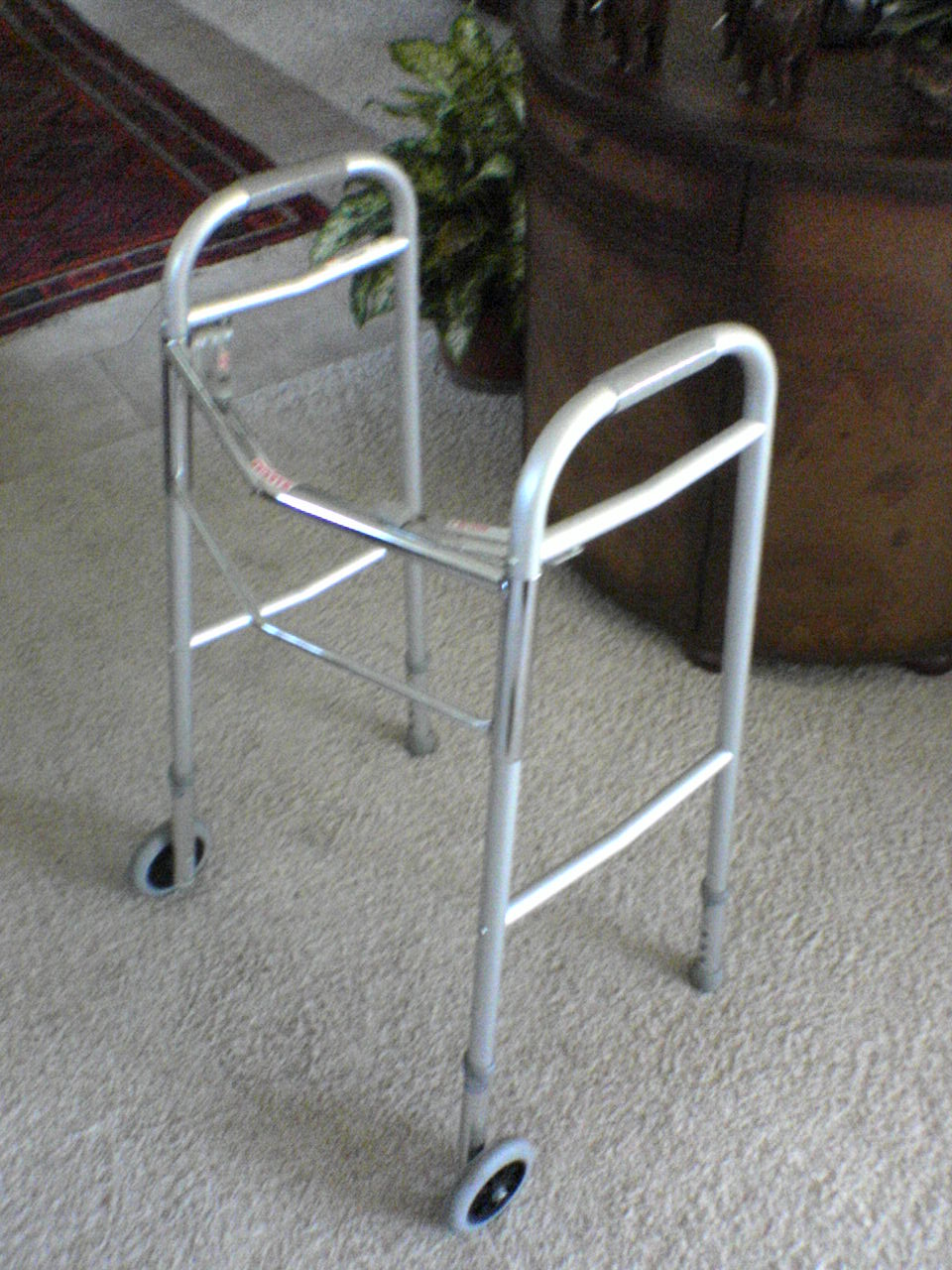
A cane only supports one side. Consider a professional assessment for a walker when the person reaches for furniture with the free hand, has weakness on both sides, needs to push heavily through the device, falls despite using the cane, or cannot coordinate the cane with the weaker leg. A walker may look like a bigger step, but using too little support can shrink independence by making every trip frightening.
How to Measure and Fit a Cane
Have the user wear their normal walking shoes and stand upright with arms relaxed. The top of the grip should align with the crease on the inside of the wrist. When holding the grip, the elbow should have a comfortable bend of about 15 to 30 degrees. These are starting checks used in clinical guidance; posture, contractures, and the reason for using the cane may change the final setting.
Do not estimate cane length only from total body height. Set an adjustable cane, ask the person to walk several passes, and look for shoulder hiking, side-bending, or a bent posture. A cane that is too high makes the shoulder lift and can be hard to advance. One that is too low encourages leaning and may reduce balance.
After choosing a position, make sure the spring button protrudes fully through the hole and tighten the locking collar if the model has one. Marking the chosen hole with a small piece of contrasting tape can help a caregiver notice accidental changes. Recheck fit when footwear changes significantly.
How to Walk Safely With a Cane
Unless a clinician gives different instructions, hold the cane in the hand opposite the weaker or painful leg. Move the cane forward with that leg, plant the tip, then step through with the stronger leg. Keeping the support opposite the affected hip widens the base of support and can reduce load on the painful side.
On stairs with a secure rail, hold the rail in the free hand. Going up, lead with the stronger leg, then bring the affected leg and cane to the same step. Going down, move the cane and affected leg first, followed by the stronger leg. A common memory aid is “up with the good, down with the bad,” but hands-on instruction is better when balance or cognition is limited.
Never use the cane to pull up from a chair; it can tip. Push from the chair's armrests, establish standing balance, and then take the cane. Avoid carrying heavy bags on the cane wrist strap, which changes its balance. A wrist strap is for keeping the cane nearby, not anchoring it to the body during a fall.
What to Inspect Every Week
The rubber tip deserves the same attention as shoe tread. Replace it when grooves are worn smooth, rubber becomes hard or cracked, or the metal shaft begins to show. Confirm that a replacement matches the shaft diameter and seats completely. For quad and multi-tip bases, compare all feet; uneven wear can make the cane rock.
Also check the height button, collar, grip, folding joints, and shaft. Stop using a cane with a bent tube, loose handle, split grip, unreliable locking button, or frayed internal cord. Clean tips after walking through water, sand, or leaves. Even a sound tip can slide on a wet floor, loose rug, ice, or polished threshold.
Common Buying Mistakes
- **Buying after a fall without asking why the fall occurred.** Vision changes, medication effects, low blood pressure, infection, pain, and neurological problems are not corrected by a cane.
- **Choosing a quad base “for extra safety” without testing clearance.** A user who kicks or tilts the base may be less stable than with a properly selected alternative.
- **Ordering by height chart alone.** Wrist height and observed walking form are better fitting checks.
- **Ignoring the hand.** Arthritis, neuropathy, weak grip, and small hands can turn a popular handle into a painful one.
- **Keeping a cane out of embarrassment.** Color and appearance matter if they determine whether the person will use it. Let the older adult choose among clinically appropriate options.
- **Using an inherited cane without replacing the tip.** A free cane is not a bargain if it is the wrong height or has hardened rubber.
Frequently Asked Questions
Are quad canes safer than regular canes?
They provide a broader base when all feet are flat, but they are heavier and more cumbersome. A quad cane can be safer for the right gait and less safe if its base catches obstacles or the user advances it tilted. Let the person's balance, strength, pace, and environment determine the choice.
Can a cane prevent falls?
A correctly fitted cane may improve balance and confidence, but no cane prevents every fall. Training, medication review, vision care, strength and balance work, suitable footwear, and removal of home hazards may all be part of a fall-reduction plan.
Does Medicare pay for a cane?
Original Medicare Part B may cover medically necessary durable medical equipment prescribed for home use when both the prescriber and supplier meet Medicare requirements. Coverage and out-of-pocket cost depend on the plan and supplier. Verify eligibility before buying at retail, since reimbursement is not automatic.
Should the cane go on the strong or weak side?
Usually it goes in the hand opposite the weak or painful leg. That means a painful right hip is typically paired with the cane in the left hand. A therapist may give different instructions for a specific neurological or orthopedic condition.
How often should a cane tip be replaced?
There is no useful calendar interval because wear depends on mileage, surfaces, gait, and storage. Inspect it weekly and replace it as soon as tread is shallow, rubber is cracked or hardened, or the cane sits unevenly.
The Bottom Line
For most seniors who need light everyday support, the **Drive Medical Gel Grip Offset Cane** is our best overall choice because it is simple, broadly adjustable, and easy to service. Choose the **Drive folding gel-grip model** when storage is essential, the **HurryCane Freedom Edition** when a compact self-standing design improves adherence, or the **NOVA Large-Base Quad Cane** only when the user genuinely needs and can manage its wider support.
Before ordering, measure wrist height and be honest about how much support the person needs. If they are falling, leaning hard on furniture, or becoming rapidly less steady, skip the product experiment and arrange a clinical gait assessment.
Sources
- Mayo Clinic: Tips for choosing and using canes
- American Academy of Orthopaedic Surgeons: How to use crutches, canes, and walkers
- Drive Medical: Gel Grip Aluminum Offset Cane
- Drive Medical: Folding Cane with Gel Grip
- HurryCane: Freedom Edition
- NOVA: Large-Base Quad Cane
- NOVA: SugarCane
- Drive Medical: Glow N' Go Folding Cane