
best
Best Handrails
Families comparing Handrails need a tighter shortlist, simpler criteria, and buying guidance rooted in real home use.
The best handrails for an aging parent are the ones they can grasp comfortably along the whole stair route, with secure supports and usable ends. For a straightforward wall-mounted run, start by comparing **EZ Handrail’s round aluminum kits with wall returns** and **Promenaid’s configurable handrails**. For steps without a suitable adjacent wall, **Simplified Building’s Surface 518** is a post-mounted option worth discussing with an installer.
Those are different solutions to different layouts. Buying a rail before checking the staircase can leave you with the wrong length, awkward mounting positions, or an expensive kit that still needs additional parts. This guide helps families narrow the choice before ordering.
These recommendations are based on published product information and installation considerations, not hands-on testing or a comparative fall-prevention trial. Prices are U.S. dollar snapshots checked September 16, 2026; final configuration, delivery, tax, and installation can change the total.
A shortlist organized by the staircase
| Candidate | Best fit to investigate | Main tradeoff | Price approach | | --- | --- | --- | --- | | EZ Handrail round aluminum kit with wall returns | A straight run beside a suitable wall | Check exact usable length and whether the 1.9-inch grip feels comfortable | Compare the same length, finish, and end style at checkout | | Promenaid configured handrail | A project needing selectable lengths, finishes, brackets, or ends | More configuration decisions; a default online price may describe a very short rail | Save a complete configured quote | | Simplified Building Surface 518 | Steps needing floor-mounted posts | The supporting surface and end treatment need close review | Manufacturer lists a starting price of $699.99 |
The Surface 518 price comes from the supplier’s Signature Handrail Line. It is a starting hardware price, not an installed project estimate. The recommendations in the table are editorial judgments about likely fit; none establishes that a particular installation meets your local requirements.
Before comparing colors, decide whether the project needs a wall-mounted rail, a rail on posts, or an entire guard system. A handrail provides a grasping surface. A guard protects an open edge. A single handrail should not be assumed to replace the barrier required beside an open staircase or landing.
EZ Handrail: a useful starting point for straight wall-mounted runs
EZ Handrail’s manufacturer catalog lists round aluminum kits with a 1.9-inch diameter, wall-return ends, and mounting brackets for interior or exterior use. It offers several lengths and finishes, and also lists kits with end caps instead of wall returns. Compare the exact model, because the product family contains materially different end arrangements. See the EZ Handrail round handrail catalog.
Our reason for shortlisting the wall-return version is practical: it gives families a clearly identifiable combination of rail, brackets, and ends to discuss with a contractor. It can be a sensible first quote for a straight basement or entry stair where the wall construction is suitable.
Do not choose the diameter from a picture alone. Ask your parent to try a sample or a comparable securely installed rail from a stable standing position. Notice whether their fingers wrap naturally and whether their thumb can oppose the fingers without strain. Someone with small hands may prefer a different profile even when the advertised dimensions satisfy a design standard.
Length deserves equal attention. Ask the seller whether the listed measurement includes the curved ends, and have the installer confirm the supported gripping length across the staircase. A nominal eight-foot product name does not answer where the first bracket goes or whether the hand remains supported at the last step.
For a current price example, Home Depot’s aluminum handrail listings displayed the six-foot textured-black curved-end kit, model EZA6KWR-HB, at $78.32 when checked. Treat that as one retailer’s listing snapshot. Verify the model, local availability, included hardware, and final price before using it in a budget.
**Choose this candidate when:** you have a mostly straight route, want a round aluminum surface, and can confirm the kit’s dimensions and mounting plan. **Keep comparing when:** the grip feels too large, the route changes direction, or the installer cannot place the supplied supports appropriately.
Promenaid: useful when configuration matters
Promenaid’s configurator offers choices of handrail finish, hardware finish, flush ends or ADA returns, bracket style, length, and bracket quantity. It identifies Endura anodized aluminum as suitable for indoor or outdoor wet or dry locations, while recommending TrueWood wood-wrapped rails for dry locations. These options are documented in the manufacturer’s handrail configurator.
Our assessment is that this makes Promenaid worth investigating when a stock kit leaves too many compromises. For example, a family may want a wood appearance in a dry hallway and a different finish at the exterior entrance, while discussing both projects with one supplier.
There is an important buying trap: the configurator’s displayed default price may refer to a very short rail. During this review, it showed $97.47 for a twelve-inch configuration. That is not a meaningful price for a full staircase. Enter the actual required dimensions and options, then save the resulting specification and quote.
If the route includes a corner, landing, or change in slope, send the supplier a dimensioned sketch. Request a parts list that includes each connector, bend, end, and support. Do not assume that two independently ordered straight kits will create a smooth continuous route when joined.
The family’s job is to describe how the staircase is used; the supplier and installer should settle the assembly details. Explain where your parent currently releases the existing rail, changes hands, or pauses before stepping onto the landing. Those details help distinguish an attractive configuration from one that solves the actual problem.
**Choose this candidate when:** you need more control over the final specification and are prepared to check a complete parts list. **Keep comparing when:** a simpler stock kit meets the same need at a lower installed cost, or your preferred finish is unsuitable for the location.
Surface 518: worth considering where wall mounting is unavailable
Simplified Building describes its Surface 518 as an offset, floor-mounted handrail with an adjustable stair angle, a smooth surface, and open ends. Its Signature product listing gives a starting price of $699.99. This places it in a different purchasing category from a basic wall rail.
Our reason for including it is the mounting arrangement. A short set of outdoor steps may have no wall in a useful position, making posts the relevant option. However, the advertised flexibility does not establish that the existing steps can accept the required anchoring.
Have the installer examine the proposed base locations before ordering. Send photographs showing the whole stair, the edges of the steps, and the surface where each post might sit. Cracked concrete, thin decorative finishes, and uncertain wood framing call for a more detailed assessment than a product photograph can provide.
The open ends are another specific decision point. Ask whether the supplied design is appropriate for this location or whether different ends, returns, or a different system are needed. A handrail described as adjustable is not automatically a complete accessibility solution.
Compare the finished project with a local fabricated rail quote. Include site preparation, anchors, coating choices, delivery, and labor on both sides of the comparison. A higher hardware price may still be acceptable if it suits the layout, but a kit should not win simply because its assembly appears straightforward online.
**Choose this candidate when:** the project needs post mounting and the installer can verify the base construction and end details. **Keep comparing when:** an open edge also needs a guard, the mounting surface needs major repair, or a different end arrangement is essential.
What matters more than the brand
A handrail purchase succeeds when the gripping surface, route, and supporting structure work together. Use the following checks to eliminate unsuitable options before treating price as the deciding factor.
A grip your parent can actually use
The U.S. Access Board’s ADA standards specify circular handrail diameters of 1¼–2 inches, at least 1½ inches of clearance from adjacent surfaces, and a gripping height of 34–38 inches above stair nosings. They also address continuity, rounded edges, and surfaces free of sharp or abrasive elements. These are useful reference points for discussing a proposal. They are not a determination of which rules govern your private home; confirm applicable requirements locally. See Section 505 of the ADA standards.
Within an acceptable specification, comfort still differs. Ask your parent which sample feels easiest to hold. Try the comparison in the conditions that matter, such as with the gloves normally worn outdoors, without asking them to attempt an unsafe stair trial. Avoid adding improvised wraps or tape before asking the manufacturer how they affect the intended gripping surface.
A route that matches the whole flight
Draw where the hand starts before the first step and where it finishes after the last one. Include the landing and any turn. A short rail in the middle of the flight may leave the most awkward transition unresolved.
Look at both travel directions. A rail that feels convenient going upstairs may be on the less useful side coming down. If your parent has difficulty using one hand, bring that information to the installer and an occupational therapist before choosing the layout. Do not assume that moving a rail to one side resolves every difficulty.
Supports that match the building
Ask who will verify the backing, bracket positions, fasteners, and condition of the supporting surface. The answer should identify the actual wall or step construction. A statement that a kit includes screws does not show that those screws suit your home.
For an older plaster wall, for example, the question is where the reliable structural support lies behind the finish. For outdoor masonry, it is what material receives the anchors and whether its condition is suitable. Leave the selection of anchors, embedment, and support spacing to the product instructions and a qualified installer familiar with the site.
Measure these details before requesting quotes
Make one shared worksheet so every supplier is pricing the same project. Record the stair location and attach photographs taken from the top, bottom, and side where safely possible. Include close-ups of the existing brackets or proposed post bases.
1. **Route:** Identify every flight, landing, turn, and doorway that affects the handrail. 2. **Dimensions:** Have the installer confirm the sloping run and intended rail length; a horizontal floor measurement alone is insufficient. 3. **Mounting surfaces:** Note wall finish, visible framing information, concrete or masonry condition, and any previous repairs. 4. **Existing barriers:** Show the current guard, balusters, and open edges so handrail and guard work are priced correctly. 5. **Obstructions:** Mark light switches, door swings, heating equipment, and any stairlift equipment. 6. **User preferences:** Record comfortable grip samples, preferred finish, and the specific transition your parent finds difficult.
Where a stairlift is present, ask its installer to review clearance with the proposed handrail and the chair in its relevant positions. A photograph showing both products on another staircase does not establish compatibility in yours.
The worksheet also prevents a common misunderstanding: one contractor may quote for replacing an existing rail while another includes a second rail, wall repairs, and repainting. Those totals cannot be compared fairly until the scope matches.
Budget for the installed result
The product price is only one line in the estimate. Request separate amounts for the rail assembly, supports and ends, site preparation, installation, and finishing. Include shipping and tax where applicable. Ask whether removal and disposal of the existing rail are included.
For a simple wall installation, the biggest uncertainty may be hidden backing. For a post-mounted outdoor project, it may be the condition and geometry of the base. An installer should explain what is known, what still needs inspection, and what would trigger an additional charge.
Use a short comparison template:
- Exact manufacturer, model, finish, and final dimensions.
- Included brackets, returns, connectors, posts, and fasteners.
- Work needed to make the supporting structure suitable.
- Labor, delivery, cleanup, and any required inspection.
- Warranty responsibilities for the product and installation separately.
- Return restrictions for cut, configured, or special-order parts.
If money is tight, ask for a simpler finish or configuration that preserves the necessary function. Do not solve the budget problem by shortening the route or removing supports that the design requires. It may be more useful to request a second quote with the same specification than to compare a bare rail with a complete kit.
This guide does not provide a national installed-cost range because the shortlisted products cover substantially different projects. Use the verified hardware examples as reference points, then obtain a site-specific installed quote. A low online price cannot predict the cost of repairing an unsuitable wall or step.
A practical family decision process
Consider a parent who has a serviceable decorative banister on one side of an indoor staircase but struggles to grasp its broad top. Start by describing the grip problem to an installer. The appropriate project might be an additional graspable rail; it does not automatically require replacing the decorative assembly.
For that situation, compare the EZ Handrail wall-return kit with a fully configured Promenaid quote. Ask the same questions about length, comfortable grip, finish, and attachment. Choose based on the completed installation and the parent’s preference, not a generic ranking.
Now consider three entry steps with no adjacent wall. The first task changes: confirm where posts can be mounted and whether the edge requires a guard. A Surface 518 quote may be relevant, but a wall-mounted kit is not a comparable substitute merely because it costs less.
Finally, consider a staircase with a turn and a narrow landing. Send a measured layout to suppliers before ordering straight sections. Ask them to show where joins and ends land relative to the walking route. If no proposal explains the transition clearly, arrange a site visit before committing to the parts.
In all three examples, the useful sequence is the same: identify the difficult movement, establish the mounting and route constraints, compare complete proposals, and then select the finish. That sequence keeps the purchase tied to the home rather than the marketing photograph.
Questions to settle at installation handover
Walk through the finished project with the installer before treating it as complete. Ask them to explain how the supports were attached, confirm that the installation follows the product instructions and applicable local requirements, and show you any maintenance guidance.
From a secure position, check that the gripping surface has no obvious sharp edges, unfinished cuts, or awkward joints. Do not ask your parent to demonstrate a risky movement to prove the installation works. Report movement, rattling, or rotation to the installer rather than improvising a repair.
Keep the model number, receipt, parts list, installation photographs, and warranty information together. That record is useful if a bracket or end fitting later needs replacement. Ask whom to contact if something loosens and whether the contractor provides a follow-up inspection.
For continuing upkeep, follow the manufacturer’s cleaning and inspection instructions. Pay attention after impacts, building work nearby, or changes to an outdoor mounting surface. A fresh coat of paint does not resolve a loose attachment; the cause needs to be checked.
Frequently asked buying questions
Is a more expensive handrail safer?
Price alone does not establish that. A higher quote may reflect configuration, materials, shipping, or site work. Compare whether each proposal provides the required route, usable grip, suitable supports, and appropriate installation. Ask the supplier to explain what the extra cost changes in your particular home.
Should we buy a wood or metal rail?
Start with the location and the parent’s grip preference. Ask to handle finished samples and compare cleaning and maintenance instructions. For the products here, distinguish Promenaid’s dry-location TrueWood recommendation from its indoor-outdoor Endura option. Do not assume every wood-looking rail has the same construction or exposure rating.
Can we install a kit ourselves?
That depends on the actual attachment work and the installer’s skills. Read the instructions before buying. If locating suitable backing, evaluating masonry, planning supports, or resolving the stair layout is uncertain, obtain professional installation. A short assembly video does not assess the condition of your home.
Does “ADA” in the product name settle compliance?
No. The assembled product, installation geometry, site, and applicable rules all matter. Ask the supplier what the claim covers and have the installer confirm the requirements for the project. Selecting an advertised ADA return is one product choice, not approval of the whole staircase.
What should we do next?
Photograph and measure the route, identify the grip or transition that needs improvement, and request two quotes using the same worksheet. For the broader stair assessment, use our stairs safety checklist and guide to making stairs safer.
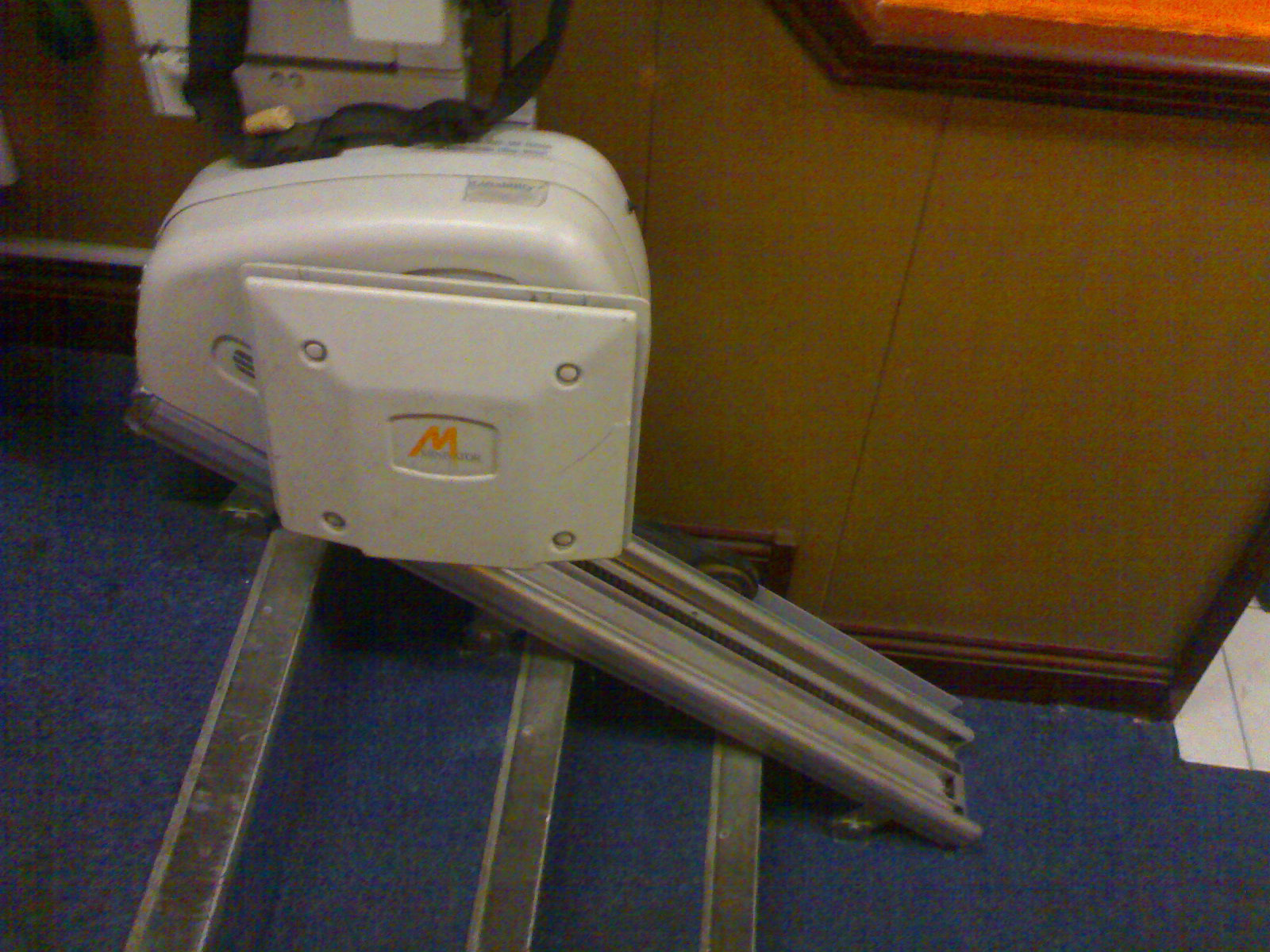
*Featured image: “Stairlift” by tico24, via Wikimedia Commons, licensed under CC BY 2.0. The photograph illustrates a stairlift installation; it does not depict or endorse the shortlisted handrail products.*