
best
Best Night Lights
Families comparing Night Lights need a tighter shortlist, simpler criteria, and buying guidance rooted in real home use.
The best night light for most older adults is the **Enbrighten SleepLite Motion-Select**. Its amber LED can stay dim after dark, brighten when it detects movement, and return to its guide-light level after 90 seconds. That combination avoids the two most common compromises: a bedroom that is bright all night or a route that stays completely dark until a sensor reacts.
For a simpler and less expensive setup, the **GE Light-Sensing Amber LED two-pack** is our value choice. Use one near the bed and one near the bathroom entrance for predictable dusk-to-dawn light. Where outlets are unavailable, the battery-powered **Mr Beams MB720A Amber Stick Anywhere Light** is easier to position along the walking route.
No small plug-in light is guaranteed to prevent a fall. Research suggests that ordinary night lights alone may provide less useful visual information than fuller ambient lighting, while automated floor-level route lighting shows promise. Treat these products as parts of a complete path from bed to bathroom, not as magic bulbs.
We selected these models from currently available manufacturer specifications, safety certification claims, control behavior, light color, placement flexibility, and maintenance needs. We did not conduct hands-on brightness, sensor, or electrical testing. Prices below were checked in August 2026 and can change.
Our Shortlist
| Best for | Product | Key behavior | Approximate listed price | Main drawback | | --- | --- | --- | --- | --- | | Best overall | Enbrighten SleepLite Motion-Select 86187 | Dim amber guide light with motion boost, or motion-only mode | $12 each | Covers both receptacles | | Best value | GE Amber Light-Sensing two-pack 76135 | Automatic dusk-to-dawn amber light | $10 per two-pack | No brightness control or motion boost | | Best adjustable brightness | GE Motion-Sensing Dimmable 67551 | Motion-only soft white, adjustable up to 60 lumens | $13 each | Can be too bright if set carelessly | | Best without an outlet | Mr Beams MB720A | 20-lumen amber motion light powered by AA batteries | About $39 per four-pack | Battery checks are essential | | Best outlet-cover design | SnapPower GuideLight 2 Plus | Dusk-to-dawn downlight with bright, dim, and off settings | $24 each | Must match the outlet style and wiring configuration | | Best for outages | GE 4-in-1 Power Failure Light 37373 | Five-lumen night light; switches to battery during outage | $12 each | White rather than amber light | | Best whole-route smart system | Philips Hue Motion Sensor plus compatible Hue lights | Separate day/night scenes across one or more rooms | Varies; bridge and lights may be needed | More setup and more failure points |
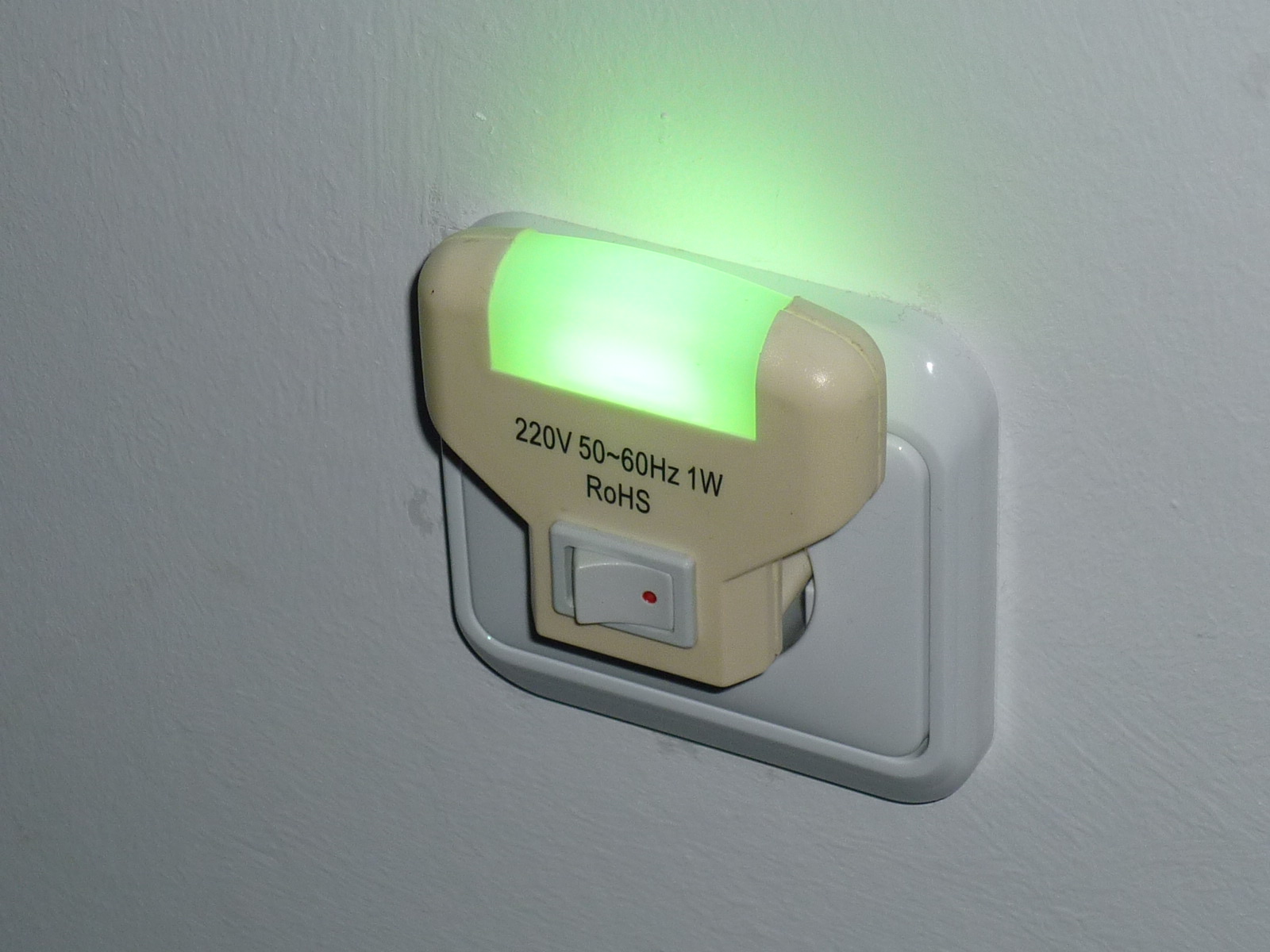
The featured image shows a generic European plug-in night light for illustration. It is not one of the U.S. models reviewed here and should not be used with an incompatible outlet or voltage.
Best Overall: Enbrighten SleepLite Motion-Select 86187
This Enbrighten model solves a practical nighttime problem unusually well. In Motion-Boost mode, it turns on at dusk at a low amber level. Motion within a manufacturer-stated 20-foot range makes it brighter, and it dims again after 90 seconds without movement. In Motion-Activated mode, it remains off until it detects movement in a dark room, then turns off after the same interval.
For many seniors, Motion-Boost is the better starting point. The dim baseline makes the outlet, wall, and direction of travel visible before the person moves. The brighter response then adds light as they sit up or approach. Motion-only mode suits someone who sleeps best in a very dark bedroom, provided the sensor catches movement before the first step.
The amber output is less visually harsh than cool white after waking. The unit is ETL certified, stays cool to the touch according to its manufacturer, and comes in white, brushed nickel, and oil-rubbed bronze finishes. The $11.99 listed price is reasonable for dual-mode behavior.
The body covers both outlets, so it is a poor fit where a medical device, phone charger, or lamp already needs that receptacle. It also has no published lumen figure on the product page, making comparison with brighter products difficult. Buy one first and test the actual room before equipping the entire route.
Position the sensor so getting out of bed triggers it, not merely walking past it in the hallway. Check the return trip too: a sensor that sees a person leaving the bedroom may not see them approaching from the bathroom.
Best Value: GE Amber Light-Sensing Two-Pack 76135
The GE two-pack is the easiest recommendation when a caregiver wants something predictable, inexpensive, and difficult to misconfigure. Each unit uses an amber LED and a light sensor to switch on in darkness and off in daylight. There is no app, timer, charging schedule, or motion angle to manage.
At $9.99 for two, the set can cover two points rather than creating one bright island. One light near the bed can show the first step and mobility aid; a second near the bathroom door can mark the destination. The compact body can occupy one receptacle while leaving the other available, depending on outlet orientation and neighboring plug size.
Jasco, the manufacturer selling this GE-branded model, describes it as UL listed and cool to the touch. Its frosted lens diffuses the light rather than exposing a sharp point LED. Those are useful characteristics in a bedroom, though they do not prove the output will be adequate in a particular hall.
There is no motion boost or dimmer. Pale floors and walls may reflect enough light, while dark carpet or a long corridor may remain underlit. Because both lights react to ambient illumination, a nearby lamp or light leaking under a door may keep one switched off. Test after the household's normal lights are turned out.
Best Adjustable Option: GE Motion-Sensing Dimmable 67551
The GE 67551 is the most versatile single plug-in when the older adult needs more light than a typical night light. A scroll wheel adjusts the soft-white output from a dim glow up to 60 lumens. In a dark room, its sensor detects motion within a stated 20 feet and switches off 90 seconds after movement stops.
That range can help across a larger bedroom, open living space, or hallway. The offset plug can be oriented to cover the full outlet or leave the second receptacle accessible. Jasco lists the product as UL certified and offers white or brushed-nickel finishes.
Sixty lumens is not automatically safer. At the top setting, a small fixture can produce glare, hard shadows, or an uncomfortable jump from darkness. Begin near the low end, view it from the pillow and normal walking height, and raise it only until thresholds and obstacles are distinguishable. Aim or locate the louvered shade so the user does not see the LED directly.
This model emits soft white rather than amber and has no continuous guide mode. It is best when motion detection is reliable and adjustable output matters more than an always-visible route. If the person moves slowly, sits at the bed edge for more than 90 seconds, or frequently remains still in the bathroom, ensure another light continues the route.
Best Battery-Powered Pick: Mr Beams MB720A
The Mr Beams MB720A is useful where outlet placement—not product choice—is the main obstacle. It produces 20 lumens of amber light, detects motion from a manufacturer-stated range of about 15 feet, and turns off after about 30 seconds. Four AA batteries power each unit, so there is no cable across the floor.
The light can stand on a surface or mount to a wall. That lets a caregiver place it low enough to reveal the walking plane, at a hallway turn, near a closet that shadows the route, or inside a bathroom whose only outlet is poorly located. A current four-pack was listed around $39 by a major home-improvement retailer.
The tradeoff is maintenance. The manufacturer describes battery life as one year or more under its assumptions, but traffic, temperature, battery quality, and repeated triggering change that. Put battery inspection on a calendar rather than waiting until the light becomes visibly dim. Replace all cells in a unit together and keep loose batteries out of reach of children or anyone who may mouth or dismantle objects.
Adhesive mounting can release from dusty paint, textured walls, or humid bathroom surfaces. A fallen light becomes a floor obstacle. Use the specified hardware for the surface and tug-test the mount periodically without leaning body weight on it.
Best Built-In Look: SnapPower GuideLight 2 Plus
The SnapPower GuideLight replaces an outlet cover and shines a diffused LED bar downward, leaving the receptacles open. The Plus version adds bright, dim, and off settings while retaining automatic dusk-to-dawn operation. SnapPower lists it from $24 and says its LEDs can last up to 25 years.
It is a strong choice for a permanent hallway route because nothing protrudes like a conventional plug-in. The low downlight helps reveal the floor, and there are no batteries to charge. Multiple covers can create a consistent series of cues along a wall without visually labeling the home as adapted for caregiving.
Compatibility requires attention. Duplex, decor, horizontal, and GFCI outlets need the appropriate version. The contact tabs draw power from the outlet's side terminals; the design does not fit every wiring arrangement. Turn power off at the breaker and follow the instructions. If the outlet is loose, damaged, back-wired in an incompatible way, or unfamiliar, use an electrician rather than improvising.
The standard GuideLight 2 lacks brightness settings, so the Plus version is more adaptable for bedrooms. Even with the correct cover, the outlet's position determines where light lands. A cover behind furniture or high above a counter will not guide feet along a route.
Best Power-Outage Backup: GE 4-in-1 37373
A normal plug-in becomes useless when household power fails. The GE 4-in-1 works as a five-lumen dusk-to-dawn night light in routine use and switches to battery when an outage occurs. It can be unplugged and used as a 40-lumen flashlight or tabletop light, with high, low, and off controls.
The current version includes three AA batteries, and Jasco states up to 250 hours of battery operation on low. Its foldable plug makes it easier to hold than a fixed-prong night light. At a listed $11.99, it is inexpensive redundancy for a bedroom, hallway, or storm-prone home.
Place it where it will illuminate immediately during an outage and where the older adult can retrieve it without crossing a dark room. Practice removing and switching it while the household power is still on. Arthritis, weak grip, or cognitive impairment may make a theoretically portable light hard to use.
This white light is not as sleep-friendly as a low amber guide, and one unit should not be the only backup for stairs or a long path. Check the batteries on the household emergency schedule. Corroded or depleted cells defeat the product's main advantage.
Best Smart Route: Philips Hue Motion Sensor and Compatible Lights
A Philips Hue sensor can trigger several compatible lights at once and use different settings for daytime and nighttime. That makes it possible to create a dim warm route from bedroom to hall to bathroom rather than relying on separate sensor islands. After a set period without movement, the lights can switch off automatically.
This system is worth considering when the household already uses Hue lights and someone can maintain the app, bridge, and automations. A caregiver can tune the nighttime scene without replacing each fixture, and ceiling or lamp illumination can reveal more of the environment than a single outlet light.
It is not our first recommendation for a household that wants a simple safety fix. Cost varies with the number of bulbs and whether a Hue Bridge is needed. Software settings, wireless connections, wall-switch positions, and power interruptions add failure points. The older adult should still have an ordinary reachable switch and independent outage light.
After setup, test the automation without the phone present. Verify what happens when internet service is down, a bulb is manually switched off, or motion stops while the person is seated in the bathroom.
Why We Did Not Pick One Ultra-Bright Night Light
More lumens do not necessarily create a more usable route. A bright point low on one wall can make nearby floor detail visible while leaving the next section comparatively dark. Looking toward the source can also make it harder to see beyond it.
A small laboratory study of older adults found walking measures were best under general ceiling illumination and worst with conventional plug-in night lights alone. Adding illuminated lines that clarified the walking plane improved some measures for participants at higher fall risk. The practical lesson is not to install lasers; it is to favor even light and clear spatial cues over a single bright dot.
Another uncontrolled study installed automated LED strips along the bed-to-bathroom route. Participants reported lower fear of falling and better sleep, but the study had too few falls to determine whether the system reduced fall rates. This is promising rather than conclusive evidence.
If an older adult has poor contrast sensitivity, significant low vision, or repeated nighttime falls, ask an occupational therapist or low-vision professional to assess the full route. A brighter ceiling fixture with an accessible switch may be more appropriate than a collection of small night lights.
Dusk-to-Dawn, Motion-Only, or Motion-Boost?
Choose **dusk-to-dawn** for predictability. It suits someone who wakes confused, wants to see the room before moving, or walks slowly enough that short sensor timers are frustrating. The downside is continuous bedroom light and possible sleep disturbance if the source is too bright or visible from the pillow.
Choose **motion-only** when darkness during sleep is the priority and the sensor can see the person before they stand. It works well in halls and bathrooms. It works poorly around corners, behind an open door, or where bedding blocks the first movement.
Choose **motion-boost** when the person needs a landmark all night and more detail while walking. This is why the Enbrighten SleepLite is our overall pick. Its baseline and boosted levels cover two needs without multiple devices.
Whatever the control type, manual access still matters. The CDC recommends good room and hallway lighting with accessible switches or motion sensors. A lamp switch within reach of the bed is useful when the person needs full light to find glasses, medication, or a mobility aid.
Build a Route, Not a Collection of Gadgets
Begin in the normal sleeping position after the home is dark. Can the person see their glasses, shoes, cane, or walker? Can they reach a full room light without standing? The first automatic light should respond before their feet take weight.
Then follow the actual trip to the toilet. Mark doorways, turns, thresholds, furniture corners, and changes in floor color or height. Overlap sensor zones so the next section illuminates before the current one times out. Do not put portable units on the floor or run charging cables across the path.
Inside the bathroom, the light should reveal the toilet and the route back to the door. Keep plug-in devices away from water and use only in locations permitted by their instructions. Lighting does not replace grab bars, nonslip surfaces, or a suitable toilet transfer setup.
Finally, walk the return route. A motion sensor that works beautifully from the bedroom can be hidden by the bathroom door from the opposite direction. Test at the older adult's pace with their normal mobility aid, eyewear, and footwear. Do not intentionally create a wet or unstable test environment.
Match Brightness and Color to the Person
Amber is a comfortable first choice near sleep areas, but it is not universally best for visibility. Eye conditions, contrast sensitivity, wall color, and personal preference change what a person can see. Saturated colored light can also distort objects and floor boundaries.
Adjust the light while standing at the bed and walking route, not while crouched next to the outlet. Reduce it if the person squints, sees a sharp reflection, or loses detail beyond the fixture. Increase or add another shielded light if thresholds and obstacles remain indistinct.
Avoid relying on marketing terms such as “sleep-friendly” as medical guarantees. A warm light can still disturb sleep if it is bright, aimed at the pillow, or activated repeatedly by pets. Conversely, a slightly whiter low-level light may be safer for someone who cannot distinguish the floor under deep amber illumination.
Safety and Maintenance Checks
Choose products with a recognized certification mark and check the exact model in the U.S. Consumer Product Safety Commission recall database. Stop using a unit that buzzes, flickers unexpectedly, smells hot, discolors, cracks, or fits loosely in the receptacle.
Do not cover a light with curtains, bedding, paper, or furniture. Use indoor-only products indoors and respect bathroom location restrictions. Never solve poor outlet placement with an extension cord across a walking path.
For battery lights, record an inspection date and keep replacements available. Check adhesive or magnetic mounts for movement. Clean sensor windows gently so dust does not change their response. After an outage, verify that settings and smart automations returned correctly.
Reassess after a furniture move, new walker, vision change, hospital stay, fall, or medication change. New dizziness, weakness, confusion, urgency, or repeated near falls deserves clinical attention; a better light may expose a problem but cannot diagnose or treat it.
What to Buy First
For a typical bedroom-to-bathroom route, buy **one Enbrighten SleepLite Motion-Select** and test it at the first critical outlet. If Motion-Boost provides enough coverage, add a second unit near the destination or at a dark turn.
If the budget is tight or the person dislikes changing light levels, start with the **GE amber two-pack**. If there is no outlet where the path bends, add one **Mr Beams MB720A** rather than stretching a cord. Add the **GE 4-in-1** near the bed when outages are a concern.
Use the **GE dimmable motion model** when more output is needed and tune it from low upward. Choose **SnapPower GuideLight 2 Plus** for a neater permanent route when the outlets are compatible. Reserve a **Hue** system for homes already comfortable with smart lighting.
The best night lights for seniors turn on before the first uncertain step, reveal the floor without shining into the eyes, and keep working without a caregiver constantly adjusting them. Product choice matters, but a continuous, tested route matters more.