
best
Best Anti Fatigue Mats
Families comparing Anti Fatigue Mats need a tighter shortlist, simpler criteria, and buying guidance rooted in real home use.
The best anti fatigue mats for a caregiver household are the ones that make a specific standing task more comfortable while fitting the way everyone moves through the kitchen. A soft surface alone is not enough. The mat also needs an appropriate footprint, manageable cleaning requirements, and edges that do not interfere with normal walking.
Our first premium model to compare is the Original WellnessMat. GelPro Elite is an alternative for shoppers interested in gel-and-foam construction who can confirm current availability. Gorilla Grip's lower-priced comfort mats deserve a closer look at their warnings before purchase: the manufacturer explicitly says they are not slip-resistant. None of these products earns a blanket recommendation for someone with balance difficulties.
This is a research-based buying guide, not a hands-on product test or a clinical ranking. Product details come from manufacturer pages and the retailer listing linked below. Prices are examples observed during our September 13, 2026 review, in US dollars before tax and shipping; selected sizes, colors, promotions, and stock can change them.
A Shortlist With Clear Tradeoffs
| Product or choice | Where it belongs in your comparison | Price information observed | Main limitation | | --- | --- | --- | --- | | Original WellnessMat | First premium option to investigate for a dedicated standing station | Manufacturer homepage showed a starting sale price of $125.60 against $157; larger variants cost more | Size-dependent price and availability; a premium mat still creates a floor transition | | GelPro Elite | Alternative for someone specifically considering gel plus foam | A dependable current direct price was not available in the reviewed pages; get a quote for the exact variant | Manufacturer announced limited selection during a move; heavier sizes complicate cleaning | | Gorilla Grip Anti Fatigue Mat | Lower-cost comparison for a dry workspace, with substantial caution | Selected single-mat listing showed $51.99 | Manufacturer says it is not slip-resistant; not our choice for a fall-sensitive kitchen | | No added mat | Starting choice when walking clearance or mobility is the main concern | No mat purchase | Standing comfort must be addressed through the task setup |
Price sources: WellnessMats and Gorilla Grip's single comfort mat. GelPro's current FAQ carries the selection notice. These entries are not equivalent sizes, so the numbers should not be treated as a price-per-square-foot comparison.
Before shopping, name the task you are trying to improve. Washing a few breakfast dishes, preparing vegetables for a large family meal, and standing at a laundry counter create different requirements. A mat that is helpful at a quiet preparation counter may be awkward beside a dishwasher that opens into the same space.
Original WellnessMat: First Premium Option to Compare
The Original uses one-piece polyurethane construction. Its manufacturer lists sizes beginning at 36 by 24 inches and extending to substantially larger formats. The reviewed product page displayed a 60-by-24-inch gray variant at $209.60, reduced from $262, alongside availability and made-to-order messaging. Confirm the selected variant before relying on either price or dispatch timing. Original WellnessMat product page.
Williams Sonoma describes the Original as three-quarters of an inch thick, with tapered edges, a nonslip top, and a nonskid bottom. Those are useful specifications to investigate, but they do not establish that it will suit a particular older adult or floor. Williams Sonoma Original collection.
We would put this model first on a premium comparison list because its straightforward surface and range of footprints make it worth evaluating for a single kitchen station. That is an editorial judgment about its listed design, not evidence that it outperforms every competing mat. Its price also makes a clear return policy especially valuable.
Imagine a parent who enjoys chopping vegetables at one counter while another family member handles the stove. A compact mat might be worth considering if the standing area is separate from the route to the refrigerator. Measure that station before selecting the larger size simply because it appears more comfortable in a photograph.
Skip an expensive purchase if you cannot first establish that a raised mat belongs in the room. Paying more does not solve a narrow aisle, an appliance door that catches the edge, or a person who dislikes changing surfaces underfoot. Those problems belong to the layout decision, not the premium-versus-budget decision.
GelPro Elite: An Alternative for Gel-and-Foam Shoppers
GelPro identifies gel and foam among the Elite's construction components. Its FAQ lists the Elite at three-quarters of an inch thick, with sizes including 20 by 36, 20 by 48, and 20 by 72 inches. It gives approximate shipping weights of 13, 18, and 26 pounds respectively; these are shipping figures, not verified net mat weights. GelPro construction explanation and manufacturer FAQ.
Our reason for including it is to give shoppers a construction alternative to compare, rather than assume every cushioned mat feels the same. We have not tested whether its gel-and-foam combination feels better than the Original. A person who has tried a relative's mat should still check the exact model, because brand familiarity does not identify the construction or thickness.
Cleaning logistics deserve particular attention here. Ask the seller for the actual weight of your chosen size, then decide who will lift it to clean underneath. A large mat can be a poor household purchase if the person who does the daily wiping cannot comfortably move it. Buying a smaller footprint may be more practical than buying a longer runner.
The company says its selection is limited while it moves and joins the Matterly family. We could not establish a reliable direct price for the exact variant from the reviewed pages. Treat this as a conditional shortlist entry: verify stock, delivered cost, return eligibility, and support details before ordering. GelPro Elite collection.
If a family needs to change the kitchen this week, an uncertain delivery date is a real drawback. Do not postpone easier improvements while waiting for a preferred color. Rearranging the preparation station and making room to sit can proceed independently of the eventual mat choice.
Gorilla Grip: Read the Warning Before the Brand Name
The Gorilla Grip single Anti Fatigue Mat listing describes three-quarter-inch foam, a pebbled waterproof topside, and rubber backing. Its selected price was $51.99. Crucially, the same page explicitly states that the mat is not slip-resistant and instructs owners to address water on or underneath it and stop using it if edges curl. That warning governs our assessment. Gorilla Grip single mat specifications and warnings.
We include it as a lower-cost comparison, not as a recommended safety purchase for an older adult. A familiar brand name and the presence of rubber do not override a specific product warning. For a kitchen where someone is already unsteady or where water frequently reaches the floor, we would remove this option from the shortlist.
The separate two-pack listing shows half-inch foam mats measuring 17 by 29 and 17 by 59 inches, at $65.99 on the reviewed page. It repeats the lack-of-slip-resistance warning. Do not assume the bundle matches the single mat's thickness or solves the placement problem. Gorilla Grip two-pack.
A bundle also creates a decision that shoppers sometimes overlook: where will the second piece go? A spare mat placed in a doorway because it came in the box is not good value. Compare only the pieces the household can actually use, and leave any unnecessary mat out of the walking area.
When Leaving the Floor Clear Makes More Sense
CDC's home fall-prevention checklist emphasizes clear walking paths and removing throw rugs or securing them against slipping. It does not certify anti-fatigue mats as safe for older adults. Our practical inference is that a new raised surface should face a higher bar when the household is already addressing falls. CDC Check for Safety checklist.
If a parent shuffles, catches toes on existing edges, or uses a walker through the kitchen, begin with a clear floor and seek individual advice from an occupational or physical therapist before adding cushioning. Do not ask them to repeatedly cross a troublesome edge to see whether they can learn to tolerate it. A product return is a better outcome than making a familiar route harder.
This is also a reasonable choice in a very small kitchen. Consider a galley where the sink, refrigerator, and back door all share one narrow aisle. There may be no dedicated standing station that stays outside the walking route. The fact that a mat physically fits between the cabinets does not mean the room has a sensible place for it.
A caregiver can instead prepare ingredients at a table, organize frequently used items together, or split a long cooking session into shorter tasks. The objective is to keep the activity workable. Buying a mat is only one possible way to support that objective, and sometimes the household layout rules it out.
What Anti-Fatigue Mats Can Reasonably Offer
The Canadian Centre for Occupational Health and Safety describes these mats as a way to address fatigue from prolonged standing on hard surfaces. It also stresses that footwear, work design, and flooring all contribute to discomfort. Its selection guidance includes avoiding excessive softness and considering cleaning, slipping, and tripping hazards. CCOHS anti-fatigue mat guidance.
That guidance concerns workplace ergonomics; it is not proof that a particular kitchen mat prevents falls or treats a medical condition. We use it as a general selection framework. Manufacturers' claims about pressure relief should not be read as a diagnosis or a promise that persistent foot, knee, or back pain will improve.
For a household purchase, define success in ordinary terms: the person likes using the station, can complete the intended task comfortably, and does not encounter a new obstacle. Avoid judging success by how long you can encourage someone to remain standing. The ability to take a break still matters even when the surface feels pleasant.
Measure the Task Area Before Choosing a Size
Start with the section of counter where the person actually works. Record its width, the usable floor depth, and the distance to nearby doors. Measure with appliance doors fully open as well as closed. The dishwasher's loading position matters just as much as the kitchen's tidy appearance when everything is shut.
Next, watch a normal meal-preparation routine without adding any objects to the floor. Where does the person stand to rinse produce? Where do they turn to reach the chopping board? Which route does another household member take to the kettle? A simple sketch on paper is enough to reveal whether one mat would sit in several conflicting paths.
Use the manufacturer's full outside dimensions when sketching the footprint. Product photographs can make a compact rectangle look like a broad work platform. Conversely, a long runner may occupy far more of the room than expected. Check the orientation too: a 20-by-36-inch mat gives different coverage depending on which side faces the cabinet.
Think about stance rather than countertop length alone. The intended work area should not require the user to perform the task with one foot on the mat and the other on the floor. If a single footprint cannot accommodate the normal activity without awkward placement, reconsider the station or leave it uncovered.
Keep the measurements with the order confirmation. When the package arrives, compare the actual item with the selected size before installation. This is especially useful when a retailer lists multiple sizes or bundles on one page and the checkout defaults to a smaller option.
Compare Firmness, Edges, and Cleaning Separately
Thickness is an easy number to compare, but it is not a complete description of how a mat feels. Two products with the same listed height can have different constructions. If you have access to a showroom sample, evaluate your preference there without assuming that a brief impression predicts every household member's experience.
Request a photograph of the edge profile if the listing shows only overhead images. Look for clear information about whether the edge tapers, how the mat is delivered, and what the manufacturer says about flattening it after unpacking. An unclear listing is a reason to ask the seller for details before spending money.
Then read the cleaning instructions for the exact product. Write down permitted cleaners, drying requirements, and any flooring restrictions. Do not assume that a waterproof top means water cannot collect underneath. Nor does a wipe-clean description establish that the mat can go in a washing machine or tolerate a steam cleaner.
Consider the household's actual messes. A station used for kneading dough creates different cleanup work from a coffee corner. Deep decorative textures may be less appealing to someone who wants to wipe crumbs away quickly. A plain surface may be a better personal choice even when a patterned version matches the room.
Ask who will do the maintenance. If a caregiver visits twice a week but spills happen daily, the purchase has to work between visits. Choose only a setup the household can maintain with its available help. A cleaning requirement that nobody can carry out is part of the product's cost, even if the task takes only a few minutes.
Check Returns Before You Open the Package
For this category, return terms are part of the buying decision because fit involves both the person and the room. Confirm whether the seller accepts an opened mat after a brief household evaluation. Ask whether custom colors, oversized items, or sale purchases have different rules, and whether return postage is deducted from the refund.
Record the exact model name, dimensions, listed thickness, seller, and final delivered price. A screenshot of the selected variant can prevent confusion if the page changes later. Keep the packaging until you decide whether the mat belongs in the kitchen, particularly if the seller requires it for returns.
Distinguish a warranty from a comfort trial. A warranty may address manufacturing defects without allowing a return merely because the surface feels wrong. Read the exclusions instead of relying on the number of years in the advertising. For a household uncertain about mats, a usable return window can matter more than a long warranty headline.
Set a budget for the complete order rather than a sale banner. Delivery charges and the cost of sending back a large item can change which option is sensible. If the best-fitting size exceeds the budget, do not automatically buy a smaller size that places its edge in the middle of the working stance.
A Practical First-Use Review
Begin with inspection while the mat is out of the walking route. Check that it matches the order, has no damage, and lies as the manufacturer requires. Follow the unpacking instructions before anyone uses it. Do not hide an unresolved curl under another rug or improvise a second padded layer beneath it.
Place an acceptable mat only on a clean, dry, compatible floor. Check the empty room first: appliance movement, cabinet access, and the usual route past the station. If the mat shifts during ordinary handling or interferes with doors, resolve the placement or return it before involving the intended user.
For someone who is steady and for whom a mat is appropriate, the first use can be a short, familiar task with another person nearby. Avoid introducing hot cookware or a full sink of dishes into that first evaluation. This is a household usability check, not a balance test or a way to establish clinical safety.
Ask specific questions afterward. Did the surface feel comfortable? Did its edge draw attention away from the task? Was the footprint large enough? Did they prefer the kitchen without it? Their preference is useful information, including a straightforward refusal to use it.
Reconsider the placement when routines change. A new mobility aid, a visiting relative, or rearranged appliances can alter the kitchen's needs. Review visible wear during ordinary cleaning rather than waiting for a calendar reminder. Stop using a mat that no longer lies properly or behaves as expected.
Questions Families Often Ask
Is the thickest mat the best choice?
No. Listed thickness cannot tell you whether the surface, footprint, or transition suits the user. Compare those features together, and avoid selecting solely by which listing promises the deepest cushioning. A comfortable sample is useful, but the final decision still needs to account for the actual kitchen.
Should we buy a runner for the whole counter?
Only consider it after measuring the full route and planning how it will be cleaned. A longer mat may cover more working positions, but it also occupies more floor and can be harder to handle. One clearly defined station is a simpler starting point than trying to cushion the whole room.
Can a mat help a caregiver even if the parent should avoid it?
Possibly, if it belongs in a genuinely separate area the parent does not need to cross. A shared kitchen requires a shared layout decision. A mat that suits the person cooking still needs reconsideration if it becomes an obstacle for someone entering to get water.
Which option should we start with?
For a steady person with a dedicated standing area and a premium budget, compare the Original WellnessMat first. Investigate GelPro Elite if its construction interests you and the seller can confirm the exact order details. For a person with mobility concerns, start with an unobstructed floor and individualized advice. Treat Gorilla Grip's slip warning as a reason to exclude it from a fall-sensitive kitchen purchase.
Image Credit
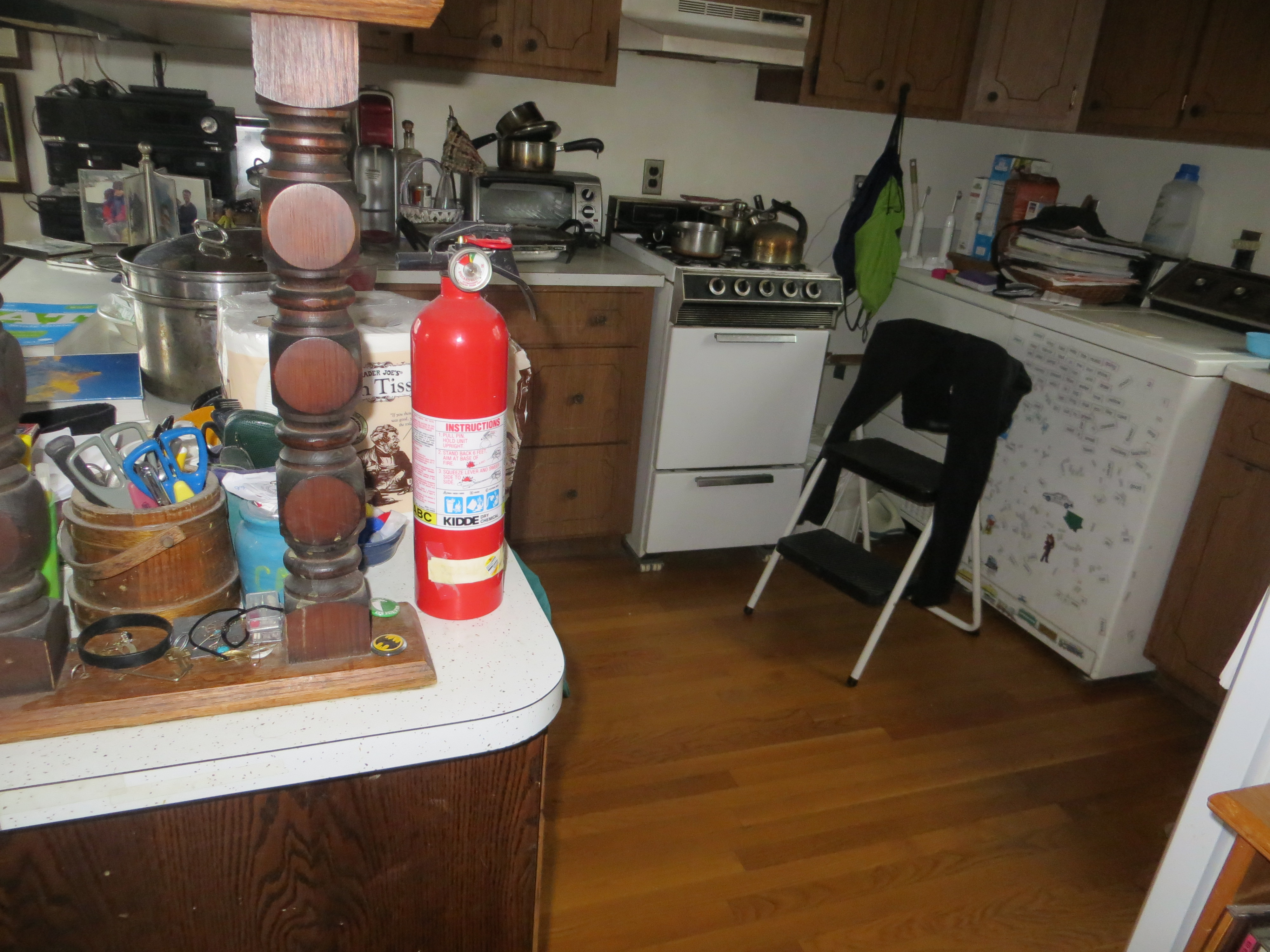
The featured kitchen-safety photograph is illustrative and does not depict a reviewed mat. “Kitchen Fire Extinguisher” by CraigKelley62, via Wikimedia Commons, is used under CC BY-SA 4.0. The downloaded image file is unmodified.