
best
Best Transfer Benches
Families comparing Transfer Benches need a tighter shortlist, simpler criteria, and buying guidance rooted in real home use.
The best transfer bench is the one that fits the tub and supports the way a person actually gets seated, moves across, and gets out again. Price, padding, and weight capacity matter, but none can compensate for legs that cannot sit securely or a bathroom too crowded to approach the seat.
Our starting candidate for a straightforward fixed bench is the **Drive Medical Transfer Tub Bench 12011KD-1**. Compare the **Carex Universal Transfer Bench** for its molded design, the **Drive Padded Transfer Bench 12005KD-1** when a cushioned surface is preferred, and the **Platinum Health Carousel** when a moving seat may suit the transfer plan. The **Drive Bariatric Transfer Bench 12025KD-1** is the higher-capacity option on this shortlist.
This guide evaluates published specifications and practical buying considerations. We have not tested these benches with users, measured stability, or independently verified manufacturer load ratings. The recommendations are starting points for a fit assessment, not guarantees of safe independent bathing.
Quick comparison
The capacities below are manufacturer-stated limits for the specified products. Confirm the model on the delivered box: a similar product name or photograph does not establish an identical specification. Supporting product links appear in the reviews.
| Candidate | Best reason to compare it | Listed capacity | Main question before buying | | --- | --- | --- | --- | | Drive 12011KD-1 | A conventional fixed bench | 400 lb | Does the full frame fit inside and outside the tub? | | Carex Universal | Molded construction and adjustable legs | 400 lb | Which dimensions apply to the current version? | | Drive 12005KD-1 | Cushioned seat and back | 400 lb | Is the seating area suitable for the user? | | Platinum Health Carousel, standard manual model | A seat that slides and swivels | 330 lb | Can the user or helper manage the controls reliably? | | Drive 12025KD-1 | A higher published load limit | 500 lb | Is there enough usable seating and approach space? |
“Best for” describes the feature worth investigating. A higher load limit is not a larger seat measurement, and a sliding mechanism does not remove the need to get onto the bench safely.
1. Drive Medical Transfer Tub Bench 12011KD-1
**Our first fixed-bench candidate for a conventional tub.** Drive lists a reversible configuration, tool-free assembly, and a seat-height adjustment range of 17.5 to 22.5 inches. The published seat width is 26 inches. Its back, legs, and arm are assembled separately. Drive 12011KD-1 specifications.
The appeal is a familiar stationary layout without a slide carriage or swivel control. Our assessment is that this is a useful starting point when the person can use a fixed surface with their prescribed transfer technique.
**Tradeoff:** the seat stays in place, so the person still needs an appropriate way to reposition across it. Check the frame footprint as well as seat width. A toilet beside the tub can leave enough room for the bench but too little room to sit down. Request the current dimensional drawing rather than assuming the seat measurements describe the space the whole bench occupies.
2. Carex Universal Transfer Bench
**A molded alternative worth comparing for its adjustable design.** Carex lists model FGB170C0 0000 with a reversible back, built-in handles, and a nominal 17.5-to-22.5-inch adjustment range. Its technical section gives dimensions of 29.75 inches wide by 19 inches deep and a product weight of 14.5 pounds. Carex Universal Transfer Bench.
**Tradeoff:** the page contains unrelated rollator text, and some illustrated measurements differ from the technical section. Treat the listed dimensions as a preliminary screen. Ask Carex or the seller to confirm the current model's footprint and height range before purchasing for a tight bathroom.
Our reason to shortlist it is the combination of molded construction and leveling adjustment. “Universal” should not be read as a fit guarantee. Show the supplier where the tub floor curves upward and ask whether every foot can sit correctly in the intended position.
3. Drive Medical Padded Transfer Bench 12005KD-1
**A candidate for someone who prefers a cushioned bathing seat.** Drive specifies a padded seat and backrest, tool-free assembly, and height changes in half-inch increments. The seat is listed as 24 inches wide by 16 inches deep. Drive Padded Transfer Bench specifications.
Our recommendation is to compare this with a firm bench when comfort is a reason the person avoids sitting for bathing. Ask for a demonstration if possible: comfort and ease of repositioning are personal, and padding alone does not establish either.
**Tradeoff:** padding needs its own inspection and cleaning routine. Ask whether replacement seat components are available. This model is not the similarly named combination bench and commode, so verify the full model number. If the person has fragile skin, wounds, or needs pressure management, ask their clinician about an appropriate seating surface instead of assuming ordinary cushioning provides that treatment.
4. Platinum Health Carousel Sliding Transfer Bench
**A moving-seat option to assess when scooting is difficult.** The standard manual Carousel has a padded seat that travels along rails and swivels, with locking positions. Platinum Health lists 12 inches of horizontal seat travel and a seat-height range of 19 to 23.5 inches on its product information page. Carousel specifications and features.
Our reason to consider it is the different movement pattern: the seat moves with the person. That may suit some transfer plans better than repositioning across a stationary bench.
**Tradeoff:** it adds controls, locking checks, and clearance requirements. Compare the complete frame dimensions and the seat's movement envelope with nearby fixtures. The standard manual model, powered version, and bariatric version are different purchases. Confirm the current manual for the exact model offered, and do not assume an accessory or capacity from another Carousel listing applies to it.
5. Drive Medical Bariatric Transfer Bench 12025KD-1
**The higher-capacity fixed option in this comparison.** Drive lists a 500-pound limit, a reversible layout, locking suction cups, and a seat measuring 26.5 inches wide by 16.5 inches deep. It assembles without tools and uses half-inch height adjustment increments. Drive Bariatric Transfer Bench specifications.
Our recommendation is to assess this model when a lower-rated bench is unsuitable, while checking body fit independently. The usable space around the arm, back, and tub wall matters just as much as the overall seat measurement.
**Tradeoff:** the word “bariatric” does not answer whether the person's transfer technique, body dimensions, or bathroom arrangement work with the bench. Request a fitting or demonstration through a medical-equipment supplier. If there is not enough clearance for the person and the needed helper, a different bathing arrangement may be required.
What these benches cost
The following are price examples from pages reviewed on September 29, 2026, in US dollars. They are not guaranteed checkout prices or claims to be the lowest available. Delivery, tax, accessories, local availability, and return conditions can change the total.
- **Drive 12011KD-1:** SpinLife displayed $113 for the specified model. SpinLife fixed-bench listing.
- **Carex Universal:** Carex displayed $80.45. Carex direct listing.
- **Drive 12005KD-1:** SpinLife displayed $150. SpinLife padded-bench listing.
- **Standard Carousel:** Platinum Health's collection page displayed $279. Verify the selected version and availability on the order page. Platinum Health collection.
- **Drive heavy-duty bariatric bench:** Walgreens displayed $189.99 under that product name. Confirm model 12025KD-1 with the seller before using this as a like-for-like quote. Walgreens transfer-bench listings.
Use these figures to distinguish the likely spending levels, then compare exact models. A local supplier's higher quote may include assembly, a fitting visit, or help resolving a mismatch. Ask which services are actually included rather than assuming every medical supply store offers them.
Decide whether a transfer bench is the right category
A typical transfer bench straddles the tub edge so a person can sit outside the tub before bringing their legs across. A shower chair sits within the bathing area and does not itself solve the problem of crossing the tub wall. Memorial Sloan Kettering describes transfer benches as useful for people who have difficulty lifting their legs to step into a tub. MSK shower and bathtub equipment guide.
Start by describing the difficult part of bathing in plain language. Is the problem stepping over the edge, standing through a shower, lowering onto a seat, moving the legs, or getting up afterward? Write down what the person can do and where someone currently has to intervene.
Bring that description to an occupational therapist or other clinician involved in mobility care. The NHS recommends professional advice before purchasing equipment for moving someone and suggests trying equipment before an expensive purchase. NHS moving and handling guidance.
A bench is not a lifting device. If the proposed routine depends on a relative lifting the person bodily across the tub edge, ask for a different transfer plan before shopping further. The product choice should follow that plan.
Measure the bathroom in three dimensions
A useful measurement sheet includes the tub, the floor beside it, and the path into the room. Take photographs from the doorway and from the end of the tub. Put measurements on the photographs or on a simple sketch so the supplier can see exactly what was measured.
Record these details:
1. **Tub wall height:** measure from the bathroom floor and from the tub floor separately. 2. **Rim width and shape:** include broad ledges, curved sides, and any door track. 3. **Flat tub-floor area:** identify where the bench feet would land, not merely the tub's maximum internal width. 4. **Outside floor area:** measure to the toilet, vanity, radiator, and other obstructions. 5. **Approach space:** show where a walker, wheelchair, or helper would be positioned. 6. **Overhead and forward clearance:** include taps, soap holders, grab bars, and the user's knee space.
Ask for both seat dimensions and outside-leg dimensions. They answer different questions. A seat can appear to fit while a splayed leg reaches the toilet base or the curved side of the tub.
Tub interiors are often higher than the bathroom floor, so the two pairs of legs may need different settings to achieve the required seat position. Have the installer follow the model's leveling instructions. The numbers on the legs are not a substitute for checking the assembled seat and foot contact in the actual bathroom.
For a sliding bench, add the space needed as the seat rotates and moves. Consider the person's legs and elbows as well as the hardware. A photograph of an empty chair between fixtures cannot show whether the full transfer will fit.
Check doors, curtains, and water management
A tub enclosure can rule out an otherwise suitable bench. MSK notes that conventional transfer benches cannot be used with glass shower doors and describes replacing those doors with a curtain. Treat any removal as a planned bathroom modification, with appropriate installation help and landlord agreement where necessary. MSK guidance on tub access.
Do not balance the bench on a door track or improvise around an obstruction. Ask the supplier to identify the intended supporting points and required clearances. If the room cannot accept that arrangement, reconsider the equipment category.
Plan where the curtain will hang around a bench that crosses the tub wall. Before the first bath, inspect the setup with the shower running and nobody seated: does water follow the bench or curtain onto the outside floor? Resolve that path instead of relying on a pile of towels in the transfer area.
A handheld shower head can make seated bathing easier and give the person or helper better control of water direction. Position its holder where it can be reached without an awkward stretch. MSK handheld shower guidance.
Choose features around a specific transfer plan
Use a short appointment or supplier demonstration to answer practical questions rather than asking only whether a bench is “safe.” Explain how the person currently sits down, which side they approach from, and whether pain or restricted movement limits a turn.
For a fixed bench, ask how the person will move along the surface. For a sliding model, ask who operates the slide and swivel locks and how that person confirms engagement. Ask whether the controls remain accessible once the user is seated and the curtain is positioned.
The Carousel manual describes locked positions for sliding and rotation, a level seat, and engaged leg-adjustment buttons. It requires the supplied safety belt to be secured around the hips and excludes users with severe cognitive, physical, or visual impairment. Review those restrictions with the clinician; this is not an unrestricted option for someone who needs extensive support. Follow the current model's complete instructions. Carousel assembly and use manual.
After surgery, bring any prescribed movement or weight-bearing restrictions to that discussion. A generic video cannot determine which movements are permitted for an individual. Ask the treating team to approve the planned transfer and equipment before the first shower.
Consider the helper's position too. Where will they stand, what will they need to reach, and can they assist without leaning over the tub wall? If there is no workable place for the helper, adding a more elaborate bench may not solve the space problem.
A buying checklist for the supplier
Send the bathroom measurements and ask for a response tied to one exact model. The following questions help turn a product recommendation into an order you can assess:
- What are the full frame dimensions at the seat height we expect to use?
- What clearance is needed above the tub rim and around the feet?
- Can the back and arm be configured for our approach direction?
- Are all required feet, locks, and fasteners included?
- Are replacement tips, suction cups, seat sections, or pads available?
- Can we arrange a demonstration or a home fitting before final acceptance?
- What is the return policy for an assembled but unused bathroom product?
Ask the seller to distinguish the product's physical weight from its user capacity and shipping weight. Listings sometimes place those numbers close together, and they are not interchangeable. Product weight matters if someone must remove the bench regularly; capacity matters for permitted use.
Keep the written answer, receipt, manual, and model label together. A relative buying replacement parts later should not have to guess which bench arrived based on its color.
Prepare for the first use
Choose a time when the person and the helper are not rushed. Assemble the bench according to its instructions, check every connection, and confirm that the delivered item matches the model reviewed with the clinician or supplier. If a part is missing or damaged, postpone use until it is corrected.
Inspect the installed bench without a person on it. Look for a foot sitting on a curve, a leg contacting a drain, an incomplete adjustment-button engagement, or interference between the frame and tub rim. Do not compensate for poor fit with household blocks or by omitting a required component.
Have the transfer technique demonstrated and practiced with the appropriate professional when assistance is needed. Include the return journey: getting out after bathing is part of the same task. Decide in advance how towels, clothing, and the mobility aid will be accessible.
Stop and reassess if the bench moves, a lock fails to engage, the person cannot reach the intended support, or either person feels unable to complete the transfer. Avoid treating a difficult first attempt as something to overcome through repeated effort. Ask the supplier or clinician to identify what needs changing.
Cleaning, inspection, and shared bathrooms
Read the model's cleaning instructions before choosing a disinfectant or abrasive product. Pay attention to joints, drainage openings, padding edges, and moving components. The point is to keep the bathing surface clean while preserving the materials and mechanisms the manufacturer designed.
Make a habit of inspecting rubber tips and suction cups, checking for cracks or loose parts, and looking for damaged padding. For a sliding model, include the locks and travel path in the check. Keep soap residue and loose bathing items away from controls.
If other household members remove the bench, agree on who puts it back and verifies the setup. A photo can document orientation, but it cannot prove that buttons and locks are engaged. Repeat the physical checks after reassembly or repositioning.
Store removed equipment where it does not block the bathroom doorway or emergency access. A bench that is too burdensome to move may be better left installed, provided everyone can still use the room appropriately. Discuss that household arrangement before purchasing.
Common questions about transfer benches
Does the highest weight capacity make a bench the best choice?
No. Capacity is one selection requirement. Seat fit, approach direction, rim clearance, stability on the available surfaces, and the transfer method still need to work. Do not exceed the manufacturer's limit, but do not use the limit as a substitute for those other checks.
Can a sliding bench replace hands-on help?
It may change the amount or type of help a person needs, but that must be assessed individually. Someone still has to get onto the seat, manage their legs, operate or supervise controls, and complete the return transfer. Evaluate the whole bathing routine with the care team.
Should we order before discharge from hospital?
Take bathroom measurements early and share them with the discharge team. Ask which equipment and assistance are needed at home and whether a trial is available. Avoid choosing solely from a hospital demonstration if the home tub, floor space, or approach direction is different.
Is a padded bench a pressure-relief product?
Ordinary comfort padding should not be assumed to meet a clinical pressure-management need. If the user has skin damage, reduced sensation, or difficulty repositioning, ask the clinician to specify suitable bathing seating and limits for use. A softer feel alone is not enough information.
What should we do if none of these fits?
Request a home bathing assessment instead of forcing a bench into the available space. Another aid, a different transfer method, or bathroom modifications may be appropriate. Until there is a workable plan, ask the care team about an alternative way to wash that meets the person's current needs.
Making the final choice
Choose the simplest model that meets the assessed transfer needs and the measured bathroom layout. Confirm the exact dimensions, load limit, required configuration, delivered cost, and return terms. Arrange fitting and training before relying on it for bathing.
The useful result is a repeatable routine the person and caregiver understand: approaching the bench, sitting, moving into position, washing, and leaving the bathroom. Buy for that complete routine rather than for an isolated feature in a product listing.
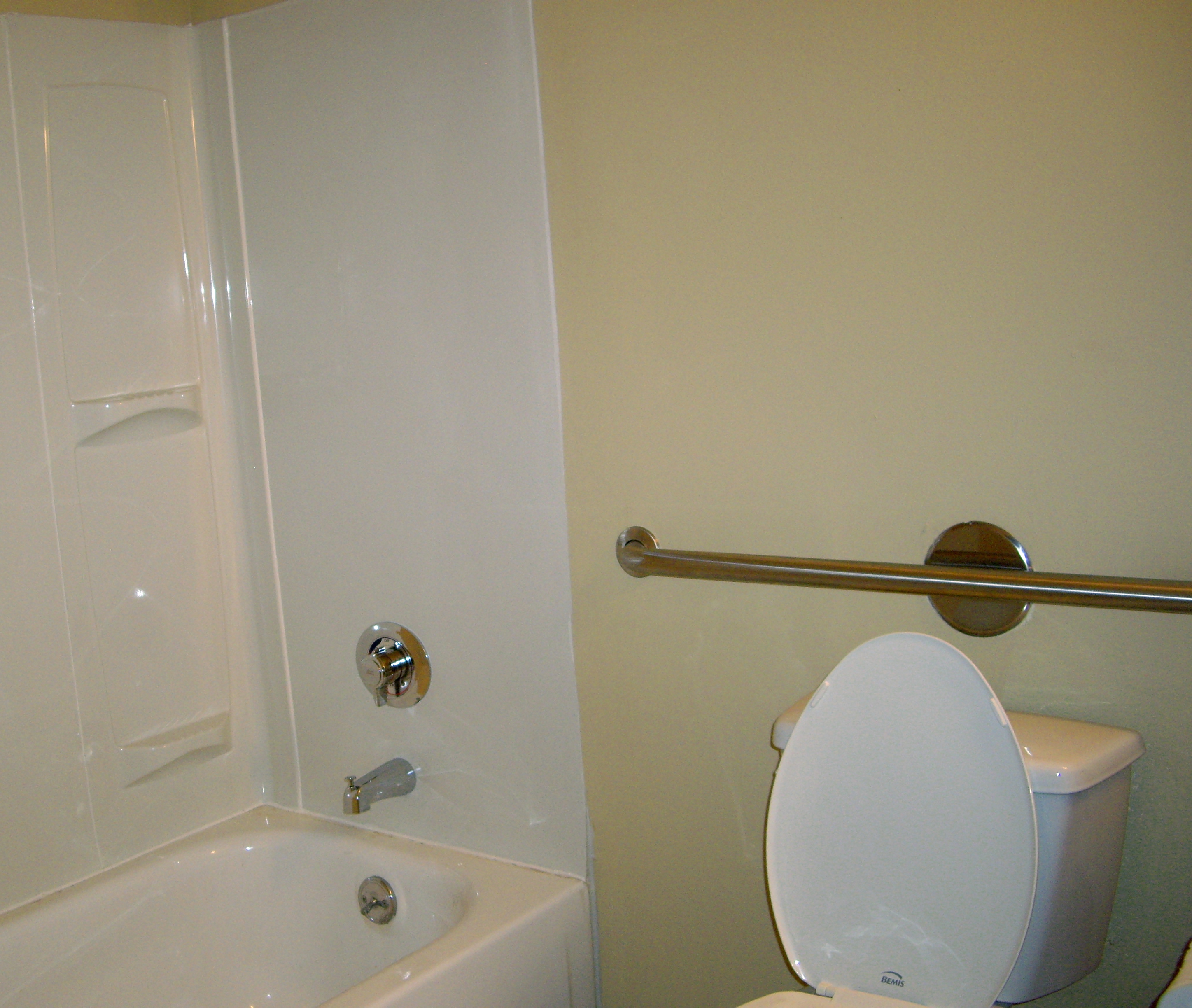
Featured image: Grab bar by Gramody, CC BY-SA 2.0. The Commons version includes cropping and color edits credited to McZusatz; no additional edits were made here. It illustrates a bathroom setting, not a reviewed transfer bench.